Introduction
In over seventy years of life, I would not need my thumbs to count the number of meaningful, detailed conversations I’ve had with anyone about God or the meaning of life in general. This excludes my wife, who, after thirty years of marriage, can recite chapter and verse of the Gospel According to Dave on a variety of subjects.
It’s not that I haven’t associated with spiritual people; I simply became a master at changing the subject and quietly exiting any conversation that might lead to the disclosure that I knew nothing worth repeating—or worse, that what I did believe might be in direct conflict with the beliefs of others.
I found my belief system in much the same way Jed Clampett discovered oil. You may need to Google this reference to see the connection. I was as much a theologian or biblical scholar as Jed was an accredited geologist.
Faith found me, but not all at once, and not in a way that immediately made sense. It began as instinctive curiosity, followed by a series of life-changing revelations that spanned over forty years.
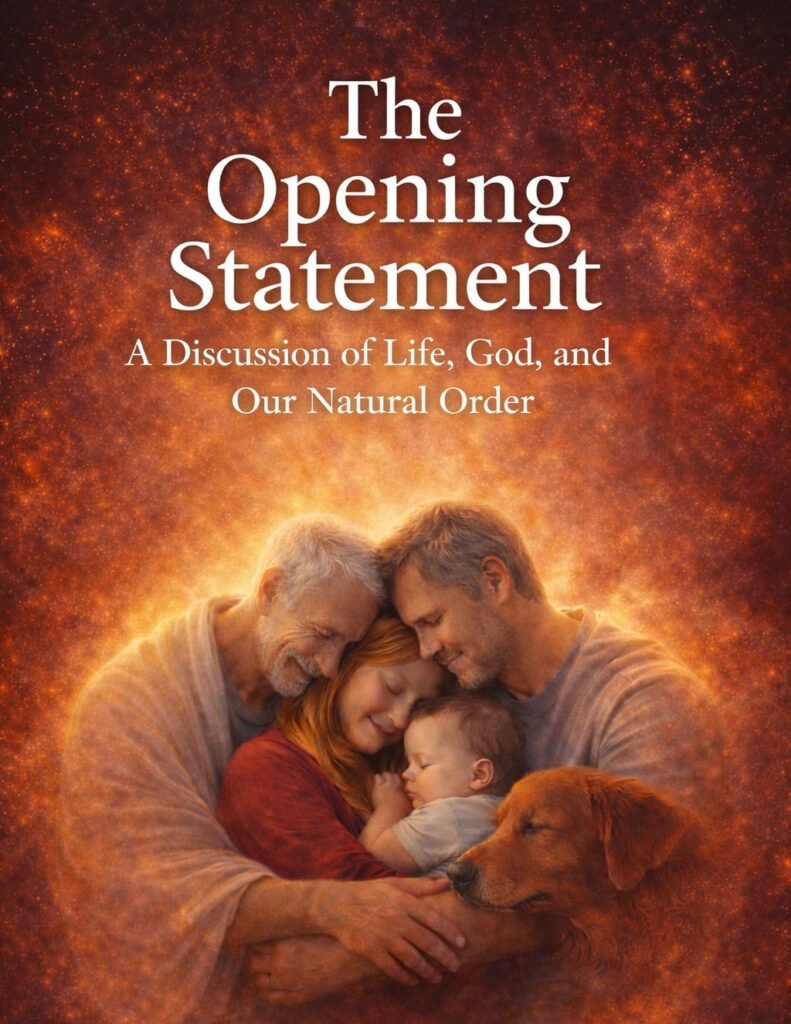
This will be my opening statement in a discussion primarily written for my family and close friends, with whom, to this point, I have kept this project largely hidden. As a part of my value system, I felt that I did not have the right to interfere with the faith or beliefs of others. A recent event, that I will describe later, inspired me to at least put it to paper. This discussion is open to anyone who wishes to contribute or may share an interest.
Before I begin, it is important to stipulate that there are elements of my belief system that fall outside most traditional religious doctrines. However, I believe that most of the revelations and concepts that I will be presenting will align with and provide validation to most faiths that consider each of us as equals and recognize the value of serving others. This would include those who seek a moral life but do not currently believe in a higher power or God.
Through the course of this discussion, I intend to show how the entire universe, including human life, is interconnected and bound by patterns and laws that govern its behavior. I will also assert that these patterns are not random, but compelling evidence of the wisdom of its Creator.
I further intend to provide validation for each concept and principle presented along with how it fits into the global framework of my belief system. I will not be using “because I said,” “he said,” or “because it was written” as validation. I will also encourage you to validate these principles yourself against your own life experiences. Finally, my findings will be simple enough for a child to understand.
The goal was to make this opening statement as brief as possible. Each topic discussed deserves more space than afforded here. These, along with future topics, can be expanded as the discussion continues.
Bio
As alluded to earlier, I’ve had no formal theological education. My life’s work, however, was in training, developing, and managing people. My career as a people manager began at the age of nineteen, managing a fast-paced headquarters office while serving in the Marine Corps. That initial team of twenty people grew to several thousand as I later managed a chain of over three hundred retail outlets.
What I learned from fifty years in management is that regardless of your business, it is always a people business. We are challenged with achieving extraordinary results from ordinary people. Assembling and inspiring a team to achieve business objectives through serving customers requires an equal focus on inspiring and assisting each individual on the team in achieving their own personal objectives as well.
Through trial, error, and sometimes dumb luck, we learn what works—and, just as important, what to never try again.
Success in business requires being a humble servant that makes happy-faces appear on everyone in your orbit—customers, employees, suppliers, stockholders…
As it turns out, these same principles are like “magic dust” in every area of life.
Biases
It is hard to approach any topic without some preconceived opinions or biases. Few topics trigger more ire than religion or politics. In the discussion that follows, we will be touching on both.
What we are taught—or what we come to believe—creates filters that can blind us to future enlightenment. It is very hard, but necessary, to set aside our biases when exposed to new information. Otherwise, we cut ourselves off from learning.
How much can we hope to learn when we talk only to people we agree with? It’s like talking to ourselves.
I came to religion with almost no bias. I have no memory of attending church with my parents or having any meaningful conversations related to faith or the meaning of life growing up.
Later, as a young adult, I had a passion for business. I studied business leaders and politicians and noticed that many attended church. There seemed to be a pattern: successful people often had a strong connection to faith. I began to suspect there was something real happening there. This curiosity was the extent of my exposure.
In hindsight, that absence of bias mattered as much as intelligence, education, or discipline in the search that eventually led to my current beliefs.
For the remainder of this discussion, I am not suggesting abandoning your beliefs, simply suspending them.
Meeting God
My curiosity for religion grew as it became obvious that I was missing something important. At the same time, I feared that I might have already missed my chance to learn as a child and would never be able to catch up.
I picked up a Bible and began reading. Very quickly, my fears were confirmed. It felt like reading a foreign language; nothing made sense. I didn’t know what to do about that then, but the question never fully left me.
Then, one afternoon in my mid-twenties, I was home alone watching television. A preacher stood before me, delivering a message that felt directed straight at me. I don’t remember who the evangelist was or the exact words he used, but the message was unmistakable: God loves me unconditionally and sent His only son to die so that I could live.
He said I didn’t need a church or a pastor. I only needed a quiet, private place to ask for God’s forgiveness and accept Him as Lord and Savior.
I don’t recall the exact words I said, if any. I confessed, forgiveness was granted, and the spiritual cleansing felt complete and absolute. It was over in an instant.
I found myself curled up, crying like a baby. No language has words for the profound peace I felt at that moment. I felt clearly saved, baptized, and born again. Forty-five years later, the memory remains just as moving.
I remember thinking, if it is this simple, why isn’t there some sort of quick-start guide to what must be humanity’s most important gift? Suddenly, I also noticed what must be billions of dollars in resources—in real estate alone—invested in spreading this good news. I couldn’t help but think that, with these resources, each gift could come with a full belly.
This was the first of many revelations for me, and my first true encounter with what I believed at the time to be God. That experience has replayed itself in my mind ever since. Not all at once, but over time, much of my belief system began there.
Knowledge Search
After my first encounter with what I believed to be God, I found myself long on faith and short on knowledge.
I immediately dug in, spending every spare minute studying the Bible and anything else I could find. At first, it seemed to be going well. But slowly and steadily, the opposite happened. The more I read and listened to sermons, the more uncertain I became. Before long, I was back to reading what felt like a foreign language, and my faith was going, going—gone.
And yet, despite the turmoil in my understanding of God and the meaning of life, all the unanswered questions in the world could not dull the sense of peace I had experienced that one afternoon. That peace never left me, even when my understanding of it did.
Decades passed.
During those years, I discovered certain pieces that clearly mattered. I knew they belonged, yet the final piece that would bind them into symmetrical order remained elusive.
These were not puzzle pieces that, once assembled, would reveal a single, magnificent image. Instead, they were the foundational tenets of a belief system—principles against which the most complex questions of life could be tested.
A grand idea or naïveté? Quite possibly both.
Important Note
The conflicts between knowledge and faith became my second major revelation.
I feel compelled to go into some detail here, not to go too deep into the weeds, but to explain the obstacles I faced. In hindsight, had this process been easier, I might never have discovered some of the ways of thinking that later proved valuable—not only in matters of faith, but in life more broadly.
Knowledge, Faith, and the BS Filter
During my search, I found conflict everywhere—conflict between knowledge and faith, and even more conflict with knowledge itself.
I will begin with the simpler of the two.
I discovered a direct conflict between knowledge and faith. They do not play well together. They cannot seem to occupy the same space.
- With absolute knowledge, no faith is required.
- Faith appears to exist only in the absence of knowledge.
The real and most controversial conflict was with knowledge itself. In matters of faith, there is no shortage of information to support any biases you may have. Convincing arguments for opposing viewpoints can sometimes be found on the same page, often written with equal confidence.
That led me to question the very definition of knowledge itself. What do we truly know?
When I separated what I thought I knew from what I could honestly say I really knew, there wasn’t much left in the latter category. I’m reminded of the generations of people who once knew, with absolute certainty, that the Earth was flat.
The answers I was searching for began to emerge from unexpected, and not always the most trusted, sources. As an amateur in all things spiritual, I had made assumptions based on the only voices available to me at the time—that certain voices or sources should never be questioned.
It had escaped my notice that scholars and historians have debated this topic for centuries.
The direct words attributed to Jesus were not written down until decades after they were spoken. The printing presses of that era were human scribes, hand-copying each manuscript.
Over centuries, language translations, editorial decisions, and disputes over authorship accumulated. Church leaders debated for generations before settling on the twenty-seven books included in the New Testament—a decision not finalized until nearly four hundred years after Jesus’s death. Then, it was decreed that all other documents, teachings, or even their mentions, should be burned at the stake and never considered.
There seemed to be a lot of loose ends to square. This includes the notion that, based on Scripture, creation is dated just a little over six thousand years ago, while there is evidence of human religious practices that date back over a hundred thousand years. (!!!)
The symbol above, “(!!!),” indicates a pause, allowing time to reread the preceding section or recover from its impact. I may need to use this symbol a few times.
I am not sharing this to denounce Scripture. Rather, this realization forced me to acknowledge that faith has always required judgment, not blind certainty.
It is my belief that a Spirit resides within each of us. It’s that little voice in our heart that tries to influence our decisions.
When we examine information with an open heart, we do not assess its validity alone. This inner spirit is always present.
I believe most people recognize this voice, even if they do not name it.
Ask yourself:
- Do you sometimes sense this inner nudge?
- Does it tend to guide you toward what feels like the right thing?
- Do you experience guilt or remorse when you knowingly act against it?
If so, you have validated the spirit within.
I came to believe that I am free—indeed obligated—to challenge everything, provided I do so with both an open mind and an open heart. This is the process I used to gather what I call my “nuggets”: studying, arranging, reconsidering, and rearranging them repeatedly.
When faced with new information, the conflict between our intellect and our heart serves as a BS filter—unBelievable Stuff filter.
Sometimes, we are asked to believe things that do not pass this “BS filter.” Our heart may want to accept them, but our intellect refuses to cooperate. This internal conflict creates doubt, which is often that little voice screaming “beware!”
You should apply this “BS filter” when evaluating this discussion and my work as well.
Many people spend a lifetime believing what they do because of how they were taught or a desire to belong. We have a deep need to belong. Yet, beneath the surface, doubt can persist.
I came to believe that just because something is written in a textbook or spoken by a teacher does not automatically make it true. Similarly, just because something is written in Scripture or proclaimed by a spiritual leader does not automatically make it so. (!!!)
The moral of a story may ring true, while the facts of the story may not be true at all. You must admit that the reverse could also be true: the facts of a story may be accurate, while the conclusions derived from them may not be.
This realization made one thing clear: I would have to learn—and unlearn—many things before I could align my intellect with the voice in my heart.
Do Facts Matter?
We seldom have definitive answers to questions based purely on facts; otherwise, they wouldn’t be much of a question. When faced with difficult issues, I often respond by asking two simpler ones:
- What level of faith do I have in this answer?
- Does it matter?
Many faith-based questions seek a moral answer. Does it conflict with your belief system? Many questions that are posed as moral questions have no relevance to my belief system at all. It is easy to get hung up on things that are not relevant to my faith. In those cases, a quick “It doesn’t matter” allows me to move to the next question.
Question: Did we evolve from monkeys or Adam and Eve?
Answer: I cannot know, and it does not matter. This is a question of history, not morality.
Question: Can I stop paying my taxes for religious reasons?
Answer: Legally, you might want to consult an attorney—or have bail money handy. Morally, based on my belief system, doing so would place an unfair burden on others. That makes it a “no.”
I offer this important disclaimer.
Regardless of how convinced I may be in what I know or believe, my heart must remain open to future enlightenment. I must be willing to examine and reexamine my positions when new or opposing views are presented. I must welcome challenge, respect differing perspectives, and change course when warranted. I must suspend my beliefs at times in the interest of finding truth.
Changing one’s position in light of new understanding is not a sign of weakness or defeat. It reveals strength of character and is evidence of integrity.
I should stand willing to place the following disclaimer on every page:
I reserve the right to be wrong.
Discussion Recap
The following are the intended takeaways to this point in the discussion.
- If we are truly seeking enlightenment, we must sometime suspend our biases.
- Faith can only exist in the absence of knowledge.
- If you know the truth, no faith is required.
- How much do we really know compared to what we only think we know?
- Is there certain knowledge or sources that we are not free to challenge?
- Most people recognize the Spirit inside us which points to what is morally right.
- We should examine everything with both Spirit and intellect, our BS filter.
- Being wrong can often be right which reveals strength of character.
Humble Servant
This leads me to my next major revelation and to the first principle of my belief system. To this point, we have only discussed methods of discerning information.
Thirty-five years ago, I received a cassette tape from a motivational speaker. As I listened and followed along, suddenly—bam—the message cut straight through me. It felt almost like a second baptism. The message itself was simple, but its impact on my life was anything but.
Years later, it became a key validation in what eventually formed my belief system. I now understand why that message struck me so deeply. I don’t believe I was listening to that tape alone. I believe it was inspired by God and delivered to my heart through the voice of Earl Nightingale.
In simple terms, his message was this:
- “Your rewards in life will match the quality and quantity of your service to others.”
- “If you want more rewards, serve more”
If that wasn’t clear enough, he added an important qualifier:
- “You must serve first, then be served.”
Over the years, I tailored Earl’s message to fit my interpretation, often summarizing it in quotes:
You cannot stand in front of a fireplace and demand, “Give me heat, and then I will build a fire.”
To get warmth from a fireplace, many things must be done correctly first. Chopping wood would be a good place to start. People I worked with over the years knew exactly what I meant when I said, “It’s time to chop some wood.”
The second insight was even simpler:
The most rewarding profession in the world is that of the “Humble Servant”.
For a long time, I did not see the spiritual connection in this idea. What I did see was how well it worked in business. If I could help create a culture where our primary focus was the success of those around us—customers, employees, suppliers, even the postman—success would eventually catch up to us.
We had to serve first to be served.
It was like magic dust. If I could make enough happy faces appear around me, before long I would have the happiest face in the room.
Serving others, however, is not merely a business strategy or a kind gesture.
Think about your own life:
Do you not feel a deep sense of fulfillment when you do something meaningful for someone else?
That feeling is universal. Even though it can’t be measured in a physics sense, it is real and undeniable. And it is not only those who receive help who walk away richer.
If you recognize that same sense of satisfaction when serving others, you have already validated Earl Nightingale’s insight for yourself.
How this “magic dust” fits into my belief system—and why it matters far beyond business—will become clear as this discussion continues.
Natural Order
Throughout this discussion, I will often refer to finding peace, harmony, or other terms that describe a state of complete fulfillment. True spiritual fulfillment—and the feelings associated with it—are, in many ways, indescribable.
At some point, it occurred to me that the desire for fulfillment and the sensation of being fulfilled might not be unique to humans at all. It may be shared, in some form, by every particle in the universe. My friends who understand physics far better than I do may wince at this analogy, but I will press on.
This was another major revelation. It was not merely something I learned; it was something I felt and repeatedly validated. I believe it plays a central role in my understanding of the meaning of life. This could easily become a discussion of its own, but for now, I will try to condense it.
I will borrow the term Natural Order and expand its meaning so we can attempt to describe it. In its simplest form, Natural Order is an advanced state of being: at peace, fulfilled, at rest, in harmony, or in perfect alignment.
It seems to me that everything in the universe is either in its Natural Order or seeking it. When an outside force disrupts that order, the instinct to restore it is almost unstoppable. Objects, people, and living systems react with whatever capacity they possess to correct the disturbance and return to balance.
Consider a guitar string.
At rest, it remains motionless until a force is applied—a pluck. That force stretches the string and pulls it in one direction. The string then uses all available means—tension, gravity, air resistance—to counter the disturbance and return to rest.
Momentum causes it to overcorrect, pulling past its original position. This oscillation continues, resonating back and forth with diminishing force until the string finally settles again to its Natural Order. It seems fitting that in musical notation, the symbol for Natural Order is called a rest.
My knowledge of physics is limited and largely observational, but I suspect that a rubber ball dropped onto a concrete floor would suffer a similar fate. It strikes the ground, rebounds, overcorrects, and continues bouncing with decreasing energy until it finally comes to rest on the floor—its Natural Order.
This instinctive drive toward balance appears throughout life, not just in physics. I will submit that all human behavior is driven by the desire to resolve conflict and return to a Natural Order.
For example, hunger creates conflict; eating resolves it—unless we overreact, creating new conflicts to resolve.
Once I recognized this pattern, I no longer felt the need to explain my behavior—or the behavior of others—as the result of some evil force compelling us to act against our will.
The devil did not make us do it!
In the Creator’s wisdom, the universe itself appears to be wired with instincts designed to move everything toward balance—toward its Natural Order.
We are constantly bombarded by forces competing for our attention.
Primal Needs:
- Survival resources — food, water, shelter, money, 401k.
- Social acceptance — the desire to belong and be relevant.
- Procreation — the drive to reproduce, find a soulmate, and continue lineage.
- Spiritual fulfillment — the search for meaning, a higher power, and purpose.
Much of our mortal life is spent reacting to these conflicts. We will dig a little deeper into each of these later in the discussion. For now, our cravings and desires are real and stem from one or more of these groups. Needs create conflict, which in turn creates desires to resolve them.
Relationship Connection
This concept seems to apply to all aspects of life, even relationships.
A conflict may begin between two people. Each reacts, often overreacts, and volleys the conflict back. This exchange can continue indefinitely, and sadly, some conflicts never resolve within a lifetime.
Now, consider a familiar scenario. One person pauses, takes a breath, and sincerely says, “I’m so sorry. This was all my fault. Please forgive me.” After a moment, the response is often instinctive and predictable: “No, no—it was me.” The exchange may volley again, but this time toward resolution, often ending in a handshake or a hug as the relationship returns to its Natural Order.
Some people become adept at what might be called Natural Order combat, using its predictability to their advantage. If I say to a stranger, “I must be one of the dumbest people alive,” they will almost certainly rush to my defense. If I say the same thing to someone who knows it’s a trick, they may simply reply, “Agreed.”
The same principle applies in reverse. Claiming to be the smartest person in the room would trigger a quick rebuttal as they point to a mountain of evidence to the contrary. Their argument would not be hard to prove.
Silly Questions—Serious Point
Why does my oatmeal get cold while my milk gets hot? A more mature question might be: why does my pizza get cold while my beer gets hot? The answer to both is Natural Order.
The more serious and specific point is environment matters. Natural Order is the tendency of all things to move toward balance with their environment. When something is out of alignment, the surrounding world quietly—but relentlessly—pulls it back. No effort required.
This principle applies not only to food and drink but also to people. Like the temperature of our food, people do not typically change suddenly; instead, they drift slowly. Whether an environment is corrosive or supportive, people can begin to change, not because they are weak, but because their environment matters.
Natural Order does not consider intent; it responds only to exposure. This would be an excellent topic for future discussions, but for now, I will simply make these points.
Environment matters, especially for children. Children do not yet possess fully formed defenses against their environment. They absorb what surrounds them—attitudes, values, and behaviors—often without even realizing it.
If we genuinely care about our children’s character, we must care about:
- The tone of their schools
- The values modeled in their homes
- The content they consume
- The behavior that is rewarded or normalized around them
Closing Thought
Hot food gets cold. Cold drinks get warm.
Not because they failed, but because they were exposed.
If we want to build strong character—in ourselves, in our communities, and in our children—we must recognize that environment matters.
When we find ourselves asking, “What’s wrong with me?” we might instead consider, “What environment am I sitting in?”
Natural Order always wins.
The only question is whether we choose to work with it or sit still and let it work on us.
Conflict and Natural Order
Conflict—conflict everywhere. As previously mentioned, various forces constantly compete for our attention. These conflicts are real and stem from genuine root causes.
The source of these conflicts might be primal needs, as listed earlier, or they could be chemical, emotional, spiritual, or have a host of other origins. This will make an excellent topic for future discussions, but for now, it is important to recognize that these conflicts are real, even if not directly measurable.
The good news is that most can be resolved without requiring much “magic dust.” For a quick test, consider these examples from your own life experiences:
Disclaimer: These examples do not permanently resolve conflicts; they only seem to temporarily medicate them, allowing us a brief sense of life without conflict.
Recall a truly funny joke or experience—not just “ha-ha” funny, but side-splitting funny. The kind of funny that leaves your eyes watering and your shorts wet. Remember how you felt inside after catching your breath? For a moment, or perhaps a few moments, peace and happiness replaced the cares and conflicts of your world. For that brief period, you found yourself at peace, your Natural Order.
Music has a similar effect on many of us. Others prefer to get lost in a sappy movie with a happy ending. Bedtime stories are like magic dust, not just for children, but also for the parents who read them. How do we describe the feeling we get when witnessing a child drift off to that peaceful, happy place?
These are not random occurrences or fairy tales; they are universal. They represent our Natural Order.
Examples like this play out in front of us every day. Until we understand them, they almost go unnoticed. Once we understand them, the satisfaction they bring becomes much more gratifying.
Unfortunately, prescription or illicit drugs, alcohol, comfort foods, and even social media can also serve as our go-to, temporary masks for conflict. Obviously, these remedies create more conflict while resolving none. Examples of this also play out in front of us every day.
Spiritual Connections
The need for spiritual fulfillment is just as real.
The first connection brings us back to the idea of the Humble Servant. Serving others is not merely an act of kindness; it brings a deep and unmistakable sense of peace and self-worth. This fulfillment is strong evidence, to me, of the Creator’s design.
The second connection is historical. As far back as we can trace, humanity has sought a higher spiritual power. People have worshiped countless forms—nature, idols, the sun itself—in search of protection, meaning, or eternal life.
When people believed strongly enough that their god would protect them, it would bring peace. Rituals, sacrifices, and acts of devotion were methods of restoring balance—of returning to Natural Order.
In those cases, faith was the magic dust, not knowledge.
Now consider this:
When we start to understand that the same actions that fulfill our spiritual needs also contribute to the betterment of the world, then we begin to appreciate the genius of the Creator’s plan: a world continually guided back toward its Natural Order.
This may be the most important point in this discussion.
Serving others fulfills our spiritual needs while improving the world around us—an ingenious design.
God, Creation, and Covenant
To this point in the discussion, we have established several foundational ideas:
- The importance of clearing our biases and preconceptions to make future enlightenment possible.
- The need to engage both intellect and heart when sorting through knowledge, accepting that this may require as much unlearning as learning.
- There is special power and spiritual fulfillment found in serving others.
- The idea that the universe—including ourselves—is not random chaos, but a system continually seeking its Natural Order for the betterment of the world.
What follows is how these ideas come together to form my belief system. Along the way, I will introduce a few additional concepts and validations that help complete the picture.
God Exists
God exists. That was my first realization, as described earlier in my initial encounter with what I believed at the time was God.
Is this the same God worshiped by Abraham, Moses, Muhammad, or Jesus? I cannot know.
Does He reign over us from heaven? I cannot know that either.
What I do believe is that a Spirit resides within me—one that has been present since the beginning, witnessing every thought, action, and intention. Some of those moments must have been difficult for Him to witness. When I am attuned to this presence, I sense gentle guidance. When I ignore it, I experience guilt and regret. This inner compass existed both before and after I discovered faith.
Is this spirit God? Is this the creator of the universe?
No one can know. But I believe it is so. I believe this presence is responsible for the ingenious world we inhabit.
I do not believe God reigns from a distant throne demanding praise, worship, or obedience. I experienced Him more as a loving parent—present, patient, and invested in my best interest.
For a long time, I struggled to understand how one God could personally engage with billions of people. Eventually, it occurred to me that in His wisdom, God does not divide His attention—He multiplies His presence. An exact iteration of God must live within each of us.
God is not like a shepherd with a billion sheep; God is like a shepherd with one sheep.
I believe many people live their entire lives without fully connecting with this Spirit within them, even those raised in religious environments. They participate in the rituals but never experience the source that inspired the rituals.
Living with God, for me, is deeply personal and private—much like living with a best friend. There have been times I disappointed Him, moments when I had to face Him with my hat in my hand and offer an honest apology. And like any good parent, He was always ready to make things right again.
I do not fear God; I fear myself.
I often refer to God as he or him, but this is habit, not certainty. I cannot know whether the love of a father is greater or lesser than that of a mother.
Creation
Among the marvels of the universe, I was created by God—equal to, but not greater than, any of God’s children. I believe we were created with two distinct, interconnected sides:
- A physical side—the body or flesh
- A spiritual side—the soul or heart
Physical Side
Our flesh side was created in the image of our forefathers. Through generations, we inherit physical traits, tendencies, weaknesses, and talents. We contribute to our lineage through procreation and to the world through work and creativity.
In the Creator’s wisdom, our strength lies not in sameness, but in uniqueness. When combined with the uniqueness of others, we form something greater than any individual alone.
We were created to work together for the betterment of the world—much like small fish that move in unison to appear larger and more formidable to predators. This is evident in our desire to belong to and be relevant in society.
Consider a hospital where great work treating and caring for people takes place every day. Think of the diverse skills and creativity that went into making it all possible.
Consider the skill and hard work of the dirt and concrete workers who created a solid foundation, or the metal workers and carpenters who constructed the structure. Think of the oil workers who delivered oil to refineries, which in turn produced the plastics found in almost everything we see. Engineers and biologists—the list goes on, ultimately leading to the medical professionals who utilize all these contributions to save and improve lives.
All these individuals, each with their unique talents, contribute to the betterment of our world. They were created equally, and none should be considered greater than the others.
Spiritual Side
The Spirit side is the real me—the spark that defines who I am.
I believe this side was created in the exact image of God and inherits many of God’s powers: self-awareness, moral reasoning, free will, the ability to plan for the future, and a persistent quest for Natural Order.
These abilities are not merely enhanced versions of what other life forms possess; they belong to an entirely different class. Moral and ethical reasoning represent a profound leap.
I remember the day I correlated God’s love for me with the love I have for my own children. “Wow, maybe I am God!” No, as it turned out. However, I do believe that I inherited those superior abilities directly from God. I’m a chip off the old block.
God’s Superpower
Among the abilities we inherit, I believe we share God’s greatest strength.
God’s “superpower,” as such, is not in moving mountains, but in seeing the redeemable good in every one of His children and offering unconditional love. These are the same feelings that I have for my own children.
Unconditional love needs little introduction or explanation. However, seeing the redeemable good in the world around us may take a little more practice.
Discarded Ducks
I’m reminded of a woodcarver at a county fair. He was carving beautiful ducks out of ordinary chunks of wood that had previously been discarded. When asked how he was able to create such treasures from piles of discarded wood, he revealed his secret:
“I simply carve away everything that does not look like a duck.”
Every person, place, or thing in the universe has its own special, redeemable good. To reveal it, we simply have to see past everything that is not so good.
It is the same with life’s circumstances. Somewhere in the chaos, there is good. I will use an example from my business background to illustrate.
Defective Product
You never know how good a business is until something goes wrong. It’s a reality: most products have the potential to fail or not operate as intended. As a consumer, you have a certain expectation of how you will be treated when dealing with companies regarding service issues. Most of our expectations are low; we expect a hassle.
Handling such failures can be a major dread for both consumers and businesses alike, unless… we can get a little “magic dust” to the business before the customer’s complaint comes in.
What if, when the customer calls, they are not transferred around to multiple people and forced to explain the problem several times? What if the company seemingly stopped everything and, as if their hair was on fire, was out fixing or replacing the defective product, far exceeding the customer’s expectations?
More often than not, this would result in the kind of customer loyalty that cannot be bought with advertising money; it must be earned. It must be earned by serving first.
With these concepts and practices in place, the business would be seeing happy faces popping up everywhere, except for one odd exception. A voice could be heard from the boardroom where someone in the sales department complained, “Our products are too reliable and do not break down often enough!”
This situation went from “poor us, we have defective products to service” to “we need more defective products to service,” all due to the God-given power of seeing the redeemable good in the world around us.
These examples validate both the humble servant concept and our ability to see the redeemable good in the circumstances we face. It also validates the role these principles play in our personal life, our business, our community, and the betterment of our world. Ingenious plan, no?
How many Commandments?
I came to believe that the only thing God truly asks of us is to treat others as we would want to be treated—to serve, forgive, and respect others as we hope to be served, forgiven, and respected.
When we serve others, we serve God. Could it be that this is why serving others brings such deep spiritual fulfillment?
Consider this:
How many commandments would be required to create a world in perfect harmony if everyone treated others exactly as they wished to be treated themselves?
Covenant
I submit that we need only one commandment—one law by which to live.
We were created free: free to act, free to think, and free to believe, so long as our actions do not infringe upon the same freedoms afforded to others.
We need only one covenant—one solemn commitment to God, to others, and to ourselves.
That covenant is to:
- Accept others as they are, imperfections included
- Forgive the shortcomings of others as we would ask forgiveness ourselves
- Offer unconditional love
“Do unto others as you would have them do unto you” is our covenant with God and with one another.
Often overlooked is the need to make this same covenant with ourselves.
- I must accept myself—not as compared to others, not as I wish I were, but as I am in this very moment.
- I must forgive myself as I would forgive a close friend.
- I must love myself as I am.
- I cannot give to others what I do not possess; respect for others begins with respect for myself.
This covenant is simple enough for a child to understand.
If God wanted us to return to Him, would He hide the very directions to His door in complexity and hierarchy? Would it require a doctorate or a committee of wise men to explain and administer? When my research arrived at a “yes” on either of these questions, I knew to throw it all out and start over.
In God’s wisdom, if we all lived by this covenant, in practice and semblance, the world would be in a better place—its Natural Order.
Free Will
This leads to another important realization—one that took a long time to understand and accept.
The concept of free will came with loose ends that were difficult to reconcile. Once finally squared, they revealed some uncomfortable truths, along with a major insight that helped confirm my understanding of life’s meaning.
In His wisdom, God created a universe governed by consistent laws—laws humanity is only beginning to understand. Within that universe, humanity was given free will. This gift allows creativity, innovation, and progress to emerge over generations for the betterment of the world.
Free will can produce extraordinary outcomes. It can also produce terrible ones.
- Terrible things happen to good people.
- Good fortune sometimes falls into the laps of bad people.
Equally tragic is how our interpretation of these outcomes can lead to confusion, the loss of faith, or even the rejection of God’s existence altogether.
Consider these examples.
Example One: A shooter enters a church during prayer and kills twenty people, most of them children. Almost immediately, people ask, “If God is real, how could He let this happen?”
Example Two: A boy on a bicycle veers into an icy pond. Hypothermic and drowning, he is rescued at the last moment by a neighbor who happened to be passing by. Locals call it a miracle from God.
Example Three: A popular religious figure was shot by a would-be assassin in the middle of an event in front of thousands of people. Millions more watched in horror on TV, triggering prayers to ring out from around the world for his recovery. Sadly, he succumbed to his injury and died.
We’ll return to these examples shortly.
The Gift and the Risk
Free will is a remarkable gift and an essential part of God’s design.
Pause for a moment and consider where humanity stands today.
Innovations in agriculture, medicine, engineering, and information technology have transformed our world. With the resources and knowledge currently available, humanity could feed, house, and care for every one of God’s children on this planet. That is difficult to deny.
Now consider the time of Moses. Or the time of Jesus. Could the same be said then? I believe not.
Look at how far humanity has progressed in the last two thousand years. Consider what the next two thousand—or even twenty—years might bring.
These achievements were accomplished by the hands of Man, made possible only by the wisdom of God. Free will affords the freedom to think, act, create, and innovate—the freedom to achieve and the freedom to fail. These accomplishments arose not in spite of free will, but as a direct result of it.
Like any good parent, I believe God would feel pride in what His children have accomplished to date. Yet this same freedom carries risk. We possess the power to care for the entire world—and the power to destroy it. Both statements are true. The question is not whether we can do either, but which path we will choose.
Intervention or Natural Order?
There are times when humanity seems to drift far from the course God intended. Moses may have arrived at such a moment, bringing commandments meant to restore alignment. Over time, however, layers of hierarchy formed, elevating a few people to great stature while burdening the many, expanding ten simple commandments into over six hundred.
Then came Jesus, over fourteen hundred years later.
His primary message was that all of us fall short—including, perhaps especially, those who claimed spiritual authority over others. His second message was that faith, not rituals or deeds, is the pathway to God.
History suggests this message was not well received by those whose relevance depended on hierarchy. The cross bears witness to that.
Fast-forward to today. Two thousand years later, a familiar pattern has emerged. A simple message has accumulated layers of structure, authority, and ritual. There are now hundreds of Christian denominations alone. It is reasonable to ask whether we have wandered off course again and are in need of another intervention.
Was it God who intervened directly, by sending messengers or prophets, or was it the natural order of the world bringing it back to order? Once the pendulum swings too far out of balance, it struggles with all its might to swing back. Miraculously or by design, the forces step up in the nick of time to return the world to order.
Before returning to our earlier examples, let me summarize this point:
God created humanity with free will. In that sense, God is responsible for everything. But I also believe God does not directly intervene on our behalf, on behalf of our friends, or against our enemies. (!!!)
Reconsidering the Examples
The church shooting: The God I know would grieve deeply—for the victims, for their families, for the shooter, and for those who cannot see that Man, not God, was responsible.
The rescued child: While it is honorable to thank God, I believe God Himself would be most honored if the credit were given to one of His children. Nothing shines brighter than a proud parent watching a child act with courage and compassion.
The Slain Leader: As millions mourned the loss of their leader and friend, many lost confidence in their faith and the power of prayer, despite assurances by well-meaning comforters that it must have been God’s will. The tragedy was magnified by confusion and doubt as they tried to find purpose in his death. The pendulum swung wide in the wrong direction with this huge loss. However, it should not be surprising that what we may be seeing now is a big swing back with a surge of, especially young people, discovering and rediscovering faith. This, I believe, is the true meaning of God’s will.
Free will makes sense when viewed within God’s design. Believing that God controls every action in the world can unintentionally undermine faith or even the existence of God.
Prayer and Relationship
I respect those who see prayer differently. For me, prayer is a private, ongoing conversation with the Spirit within. It has no formal beginning and does not end with “Amen.”
I do not believe I deserve the blessings I already have. I would never ask for more from a God who has given me the greatest gift of all: the freedom to be imperfect, paired with unconditional love.
As Jesus often said, many righteous people pray in public to draw attention to themselves. They want to be relevant, but when they do, they lose relevance in the eyes of God. However, I do not believe that this applies to most people who pray outwardly. Only God knows their heart.
Sometimes I use the word prayer to mean a solemn hope—hoping for rain, healing, or peace—without expecting intervention. I do not believe God answers individual prayers through direct action.
Faith, Community, and Civic Life
When we gather—around a meal, in fellowship, or in conversation—it honors God. Shared time is blessed time.
My vision of a church is less about sermons and more about discussion: round tables where people wrestle with real issues together, learning through shared perspectives rather than passive listening.
Faith does not absolve us of responsibility in civic life. In democratic societies, government actions reflect collective choices. By extension, we must accept responsibility for actions taken on our behalf. We must stay informed, participate, and speak thoughtfully. We may not change every mind, but if each of us changed one mind, it would make a big difference.
When we believe that we cannot make a difference, it turns out to be a self-fulfilling prophecy.
Discussion Recap
At this point in the journey, we’ve established:
- We must clear our minds and hearts of bias when examining new ideas or revisiting old ones.
- Understanding requires listening to both the intellect and the voice within the heart.
- The spiritual fulfillment that comes from being a Humble Servant is real, profound, and undeniable.
- The universe is not a random collection of matter, but the result of ingenious creation, governed in part by a natural order that seeks harmony.
- The voice within us is the Creator, who asks only that we treat others as we want to be treated ourselves.
- Free will is an essential part of God’s plan, allowing diversity of thought and action to shape a better world over time.
Morality
Morality is the act of judging willful actions—or proposed actions—against a belief system.
For my belief system, this does not require many words.
I believe we were created free. We are free to think and act in any manner that does not infringe upon our neighbors’ equal right to do the same.
This principle would result in a very small law book. It aligns perfectly with the Covenant I believe we share with God and with one another. Free will is not an accident; it is a central feature of God’s ingenious plan.
Responsibility Within Freedom
The morality of any action can be evaluated by considering its impact on all individuals within its orbit. This includes not only those directly affected, but also those indirectly influenced, now and in the future. We must include ourselves within its orbit as some actions that cause self-harm could indirectly impact others if the outcome created additional burdens on them. Because of this, morality is rarely simple in practice, even when the rule itself is simple.
Freedom does not eliminate responsibility—it creates it.
The responsibility for a specific harmful action could be viewed in a couple of ways.
- If a person commits an act that intentionally or recklessly causes harm, the person would be liable, and morally responsible.
- If the act causes harm but not intentional or reckless, the person would still be liable, but not morally responsible.
A person can also be morally responsible for inactions. Inactions that cause undue burdens or restrict the freedom or well-being of others could be deemed immoral.
Analyzing every possible action or inaction during this discussion would be impractical and is beyond the scope of this opening statement. However, what matters is not having a rule for every situation, but setting the groundwork for honest reflection:
- Who might this effect?
- Does it restrict another’s freedom?
- Does it impose a burden I would not accept myself?
- Does it set an example worthy of emulation?
This approach to morality requires us to accept that good intentions do not guarantee good outcomes and that unintended consequences are still our responsibility. It also requires us to remain open to correction when new information reveals harm we did not initially see.
Freedom and responsibility can coexist—where people are not controlled by fear of punishment but guided by respect for one another and their rights as equals.
Good and Evil
In the previous section, we discussed the morality of behavior. We have the right to judge a person’s behavior, actions, or inactions, but the same does not apply to a person’s character.
We are not privy to every action nor the intent of another individual. We cannot know their heart. Therefore, we cannot pass definitive judgment on character.
However, we cannot avoid making general assessments of a person’s nature or character. It may sound good to say that we never judge others, but is that true? Even without thinking about it, we absorb impressions based on the information at hand. It is instinctive and an important part of our defense system.
Good
I believe that good is the top rung on the character ladder. Good does not mean free of fault. A person of good character lives their life respectful of others and makes mostly good choices. However, good people are capable of big mistakes. Good people accept responsibility for their mistakes, dust themselves off, and go back at it.
Good also has power beyond the outcomes it produces. It tends to inspire good in others. Doing good can be quite addictive. It brings about a sense of fulfillment and self-worth. Do good, rinse, and repeat.
Evil Bad
I do not feel the same about evil. Evil exists only in behavior and has no power over us other than the outcomes created by evil behavior. I do not use the word “evil” to describe a person’s character. It has an unredeemable tone.
The concepts of evil could be a topic for future discussions. For this discussion, I will limit it to these points:
Earlier, I stated that the flesh/body side of us was created in the image of our forefathers. Our lineage over generations determines many of our traits, both physical and mental.
Although I do not believe that people can be evil, there can be defects/disorders that affect their reasoning as well as physical well-being. Some of these disorders could have lasting effects on their behavior.
There can also be environmental influences, drug or alcohol abuse, or a host of other potential root causes that could have long-term effects on behavior.
These behaviors may pose serious threats to the well-being of others as well as themselves. For this reason, it may require that a person be quarantined from society until proven rehabilitated or cured.
Good, Gooder, Goodest
“Good” is the target and the highest rung on the character ladder. Even language resists comparisons like gooder or goodest.
Terms like “great” and “perfect” are typically not associated with character. “Great” is associated more with achievement, while “perfect” might describe physical quality.
A person may appear perfect and yet lack goodness. Another may achieve great things without being good of character.
I suggest that even if perfect and great were considered as character rankings, you would still not likely choose them over good.
Here’s the test:
You have three children; we will name them Perfect, Great, and Good.
Each child tried their very best in this test.
- Perfect produced 100 good outcomes,
- Great produced 75 good outcomes,
- Good produced only 50.
Is there any child you would love more than Good?
Redemption
As a child, I remember getting caught in mischief and waiting for my dad to come home with his belt. Sometimes the waiting was worse than the punishment itself. I can barely recall the crying or the begging, but I distinctly remember the sense of peace that followed once it was over.
It always ended the same way. He would tell me that he loved me and that he believed in me.
That lesson stayed with me. In business and in life, I learned that even when discipline is necessary, we must leave people whole. We must give them a way out—and a way up. This is how I believe God treats us, His children.
What Redemption Means
When thinking about redemption, I offer this:
- You are not who you used to be.
- You are not who you aspire to be.
- You are who stands before God at this very moment.
Pause a moment…
Consider each of these again, slowly.
- You have no control over who you used to be.
- You have some control over who you want to be.
- But you have full control over who you are at this very moment.
This moment matters.
You can change who you are right now—before another tick comes off the clock. You can become who you want to be, starting now. With every tick that follows, your actions will confirm it.
By the grace of God, transformation does not take a lifetime. It can happen in seconds.
We do not need intermediaries. We do not need rituals or magic dust. We only need a quiet place and an honest conversation with God.
There is no script. If we sincerely confess that we have fallen short, God already knows our heart. He sees the good even when we struggle to see it ourselves.
Guilt, Regret, and Shame
This is a topic that deserves far more attention than we can give it here, but its importance cannot be overstated.
Acting outside our moral beliefs creates internal conflict. Guilt appears first, often followed by regret and eventually shame. Left unresolved, these conflicts can erode our emotional and spiritual well-being.
Guilt, however, is not the enemy.
The feeling of guilt is evidence of God’s presence within us. It serves as a deterrent, not as condemnation. Deterrence does not eliminate free will, and good does not mean perfect.
As powerful as guilt, regret, and shame can be, redemption is more powerful still.
It Begins with You
If you only remember one thing from this entire discussion, this should be it:
- You must accept yourself—not as compared to others, not as you wish you were, but as you are right now.
- You must forgive yourself as you would your closest friend.
- You must love yourself as you are, not as a future version of yourself.
- You cannot give to others what you do not have. Respect for others begins with respect for yourself.
Find your quiet place. Forgive yourself. Then turn it over to God.
Know this: it is not your deeds that honor Him, but the goodness of your heart. Trust that He will cleanse you of the burdens you carry—as you would for your own child.
Before the next second passes, you can be returned—wiser and lighter—to your natural order.
Societal Redemption
What we have discussed to this point has been redemption afforded by God and ourselves. The same rules do not always apply to others whom our actions may have harmed. We must respect and accept the consequences imposed by society.
We must also accept that others may not be quick to forgive and may never forget. We must respect those consequences. But we must not allow others to influence the peace within ourselves and with God. Respect cannot be earned back without self-respect.
Questions People Ask
A common question: Is there any behavior or sin that is not forgivable?
I believe the question is ours, not God’s, to answer. Is there a sin that we are not willing to freely and sincerely accept the responsibility and societal consequences for? Is there a sin that we cannot forgive ourselves for?
Another question often follows: If everything can be forgiven, what prevents people from behaving worse?
The answer is experience.
The cycle of harmful behavior is not broken by fear of punishment, but by realizing that spiritual fulfillment far outweighs temporary pleasure. Sin may offer momentary satisfaction, but it is quickly followed by guilt, regret, and shame.
God’s patience is greater than our failures. Giving up is a weakness of man—not of God. The God I know would want us dusted off, cleaned up, and back in the workforce. There is more good to be done. All of society is counting on our help. We can’t quit.
Mortality
I have never had a near-death experience myself. However, in the 1980s, my father suffered a severe heart attack, and for a time, we came very close to losing him. He survived and went on to live many more years.
Later, he told me about what he experienced during his heart surgery. He was visibly shaken as he would try to describe it. I could see the fear on his face—the kind of fear that lingers long after the danger has passed. The story, and the way he told it, left a deep impression on me. Looking back, I now recognize it as one of my major revelations.
My dad wasn’t a religious man, at least not outwardly. He often joked about being a “backslider.” Yet his story revealed something important: he believed deeply enough to fear that he might be in trouble with God. What he described felt like his worst imagined version of hell.
At the time, I regret that I lacked the clarity in my own faith to be more help to him.
Reflections on Near-Death Experiences
Years later, I spent time studying other near-death experiences. Many described extraordinary reunions, overwhelming beauty, and a profound sense of peace—so deep that people struggled to find words for it.
There was also a consistent correlation between the nature of their experience and how they believed they stood in the eyes of God. Those who felt at peace with God tended to have wonderful visions of what they had hoped for and more. Those who believed they were in conflict with God did not seem to fare as well.
What Changed Afterward
There’s an old saying: “It’s not what you say, it’s what you do.”
I often wondered whether studies of near-death experiences might be more revealing if they focused less on verifying the claims themselves and more on what happened afterward. Many people who reported these experiences showed lasting changes in behavior—greater compassion, reduced fear, and a deeper sense of purpose.
It might have been more revealing to interview the people closest to them—their families, friends, and coworkers—rather than debating the mechanics of the experience itself.
Mortality and Eternal Life
From the reflections of those who have survived near-death experiences, my understanding of the nature of our Creator, and the natural order of our world, I’ve come to believe the following.
As much as I would like to believe differently, I am not the center of the universe. The world does not revolve around me. I am a small, but not insignificant, part of the Creator’s master plan.
My purpose in life is to serve along with others, contributing my inherent skills, creativity, and labor to the betterment of the world. Then, with honor and gratitude, I will return to the ground from which I came to make room for the next generation, who will be bringing their skills and talents to continue where I left off.
Our Spirit Lives On
There are and likely always will be diverse beliefs regarding the question of human afterlife. The reason for this is clear. As of the date of this writing, it is not knowable. Not knowable by me or any others. This void in our understanding provides space for a multitude of theories to sprout and flourish. I have my theories as well.
Human afterlife has a couple of very different meanings. I will briefly touch on both now.
First meaning: legacy.
There is undeniable proof that our spirit lives on beyond our death. Mister Nightingale provided clues to this in his timeless message. A slight change in his wording will make it clear.
“Our rewards in the afterlife will be proportional to the quality and quantity of our service to others in our current life.”
This is ironic and a perfect fit for the image of the Creator.
Our spirit will live on through our lineage and in the memory of those in our orbit whom we have served. It is fitting that those we serve in this life will have the final say as to the nature and longevity of our legacy. This is as true as it is just.
Heroes and villains alike leave their mark on the world, and their spirit could potentially live on eternally. The nature and longevity of their legacy, like ours, will depend on the quality and quantity of their contributions to the world.
Each of us will leave our mark. The significance of this mark will depend less on what we take from the world and more on what we leave.
Second meaning: Heaven/Hell
Though I cannot know with certainty, there is evidence that our spirit survives mortal death and exists in some unknown realm. The nature of which seems to link to our alignment with God and self.
Those with this inner peace may experience an existence filled with the beauty, meaning, and peace they hoped for—along with wonders only God could conceive, including reunion with those held dear.
Those with inner conflict may experience the existence they feared.
It’s Your Move
Earl’s message reminds us that if we want more rewards in life, we must serve more people. I would expand this to include our afterlife.
Understanding this can be a gift when we realize that it is not too late to start carving our mark. Before the clock makes another tick, we can begin anew and focus our effort on the quality and quantity of our service to others which honors God and brings spiritual fulfillment to ourselves.
Would the prescription be different regardless of what theory of an afterlife we subscribed to? I think not.
Let’s get off our pews and get to chopping wood.
The Big Red Dog
Not long ago, while walking to my mailbox, which is about a hundred yards from our home, I noticed a large dog lying in the grass near the road. I wasn’t sure if it was alive until it raised its head to look at me. The moment we made eye contact, she bolted into the woods.
I couldn’t identify the breed, but she was big, red, and clearly half-starved. I could see her watching me from the woods. I went inside, grabbed a bowl of dog food, and returned to the spot by the mailbox where I’d seen her. She was still watching. I set the bowl down and called her, but she wouldn’t approach. So, I left the bowl and walked back to the house, keeping her in line of sight. Once I was a safe distance away, she made her way to the bowl and ate the food.
Later that day, I brought another bowl of food. I couldn’t see her anywhere, but I left the food. A little later, I looked out and saw her eating. I continued this routine twice a day, taking food for her. She would always wait until I had backed away before emerging from the woods. If I made eye contact before she reached the bowl, she would immediately retreat.
For some reason, I became obsessed with befriending this big red dog. Twice a day, I would go to the road, hoping she would be waiting. And sure enough, I would set the bowl of food down, back away, and she would appear.
For the next three weeks, we continued this routine. Eventually, using Vienna sausages and a little trickery, I got her to eat from my hand. She was a beautiful animal, a Rhodesian Ridgeback I believe. She had clearly been abandoned and likely abused. I’m not sure how long she had been living in the wild, but she trusted no one. I had to approach her very slowly; any sudden move would send her running off.
Finally, after two months of this routine, she moved from the woods to sleep under a cover next to the house. Sometimes she would honor me by allowing me to pet her, but she was always cautious, poised and ready to run back to the woods.
It morphed into a mutual obsession. All I thought about was what she was doing, needing, or thinking. Everywhere I went on the property, she would be within sight—not close, but never out of sight. She slept under a carport, essentially out in the open. I got her a doghouse, but she would have none of it.
I would wake up two or three times a night to look out the window and make sure she was okay. Once, I looked out just in time to see a skunk approaching where she slept. I ran outside, ignoring my wife’s warning, and barely avoided being sprayed while chasing it off.
My wife was supportive of my relationship with the big red dog, but I could tell she was beginning to think that I needed counseling.
Then, my wife went out of town to visit her mother, leaving just me and the big red dog. A major storm was approaching, bringing thunderstorms and rain for a couple of days. Thus began 48 hours of nonstop terror for the big red dog. As it turns out, the only thing she feared more than people was thunder.
It was cold, raining sideways, with nonstop lightning and booming thunder. Finally, I brought her into the house for the first time and made her a pallet on the living room floor. She toggled between shaking in terror and nonstop pacing back and forth. We went outside, then inside. Nothing I could do calmed her. She would hardly let me touch her, except to stop her from tracking a muddy mess over the rest of the house.
The storm started around noon. It was now four in the morning, with no sign of calming down. Finally, during the worst of it, I reached out, grabbed her, and held her tight. I placed my hand on her head, not as if to pet her, but more like a gentle press. As I held it there, she began to melt—slowly at first, and then almost like an ice cube on hot concrete. She sank down and lay across the top of my feet.
The rain was still pounding in a steady roar. An occasional boom of thunder would make her flinch a little, but that big red girl had found peace.
I’m sitting there, dripping wet, with a big, wet dog lying across my feet. I’m afraid to move or remove my hand from her head, thinking that she would come out of her trance and start it all over again. Suddenly, it occurred to me: I had just witnessed a miracle. I witnessed this big red dog, in the face of horrifying fear, finding her savior.
No, I’m not a god. But at that moment, she surrendered and placed her unconditional trust in me. She lay asleep with the storm still raging. This was one of the most moving events I have ever witnessed. It further validated my entire belief system.
My whole world, for a moment, like hers, was in its Natural Order.
In Summary
As this discussion draws to a close, I want to gather the core tenets that shape my belief system.
- I believe we must clear our minds and hearts of bias when examining new ideas or revisiting old ones.
- I believe that understanding requires listening to both the intellect and the voice within the heart.
- I believe the spiritual fulfillment that comes from serving others is real, undeniable, and the foundation of our purpose in life.
- I believe the universe is not a random collection of matter, but the result of ingenious creation, governed in part by a natural order that seeks peace and harmony.
- I believe the voice within us is that of the Creator, who asks only that we treat others as we would want to be treated.
- I believe free will is an essential part of the Creator’s plan, allowing diversity of thought and action to shape a better world over time.
- I believe morality is measured by how our actions and intentions affect the freedom, dignity, and well-being of others.
- I believe deeply in the power of redemption: I am not who I once was, nor who I hope to become, but who stands before us right now.
- I believe goodness resides within each of us, and that evil has no inherent power beyond the harm created by behavior.
Think back to the story of the Big Red Dog. This was the event that prompted me to put to paper the beliefs that, up until now, I kept quiet, for fear of influencing the faith of others.
She knew nothing of Scripture. She did not recite doctrine or perform rituals.
She does one thing—trusts.
This trust was not coerced or demanded; it was earned through patience, consistency, and unthreatening love.
This story produced two validations of Natural Order.
- The big red dog finds peace through faith.
- I found peace through service.
You have probably experienced similar events in your life. The more we understand their true meanings, the more profound the experience becomes.
And finally, I believe this:
Even if you cannot accept a higher power or creator, living a life rooted in service to others, personal responsibility, forgiveness, and respect would still lead—without question—to a better and more humane world.
Final Thoughts
I hope this is only the opening statement—to an ongoing discussion about life, God, and our Natural Order. I welcome your challenges to the beliefs outlined in this discussion.
Speaking only for myself:
I believe I was created in the exact image of God, and that this same God lives within me. From Him, I inherited the ability to see the good in others and to love them unconditionally.
I know I have fallen short of what I have been inspired to understand. Yet I also trust—deeply—that if I find a quiet place, bow my head, admit that I have fallen short of being that humble servant, and commit again to serving others with the same forgiveness and love I now seek, I will be received with grace.
I believe I will be cleansed—not by ritual or words—but by the warm tears of God as He anxiously welcomes me home.
And then, before another tick can come off the clock, I will not be who I used to be, nor who I hope someday to be. I will be who stands before God at this very moment.
For this moment—and for as many moments as I choose—my world will be in its Natural Order.
Amen.